
ListingOK
AI-powered revenue management for short-term rentals and hotels. Dynamic pricing, market insights and channel manager in a single SaaS platform.
At a glance
| Client | ListingOK |
|---|---|
| Project type | SaaS B2B product — revenue management |
| Duration | March 2023 — present (over three years, in continuous evolution) |
| Tec2020 team | 1 CTO + 2 developers |
| Tech | React · Vite · TypeScript · Node.js · Express · Firebase Auth · Azure · Airbnb market data pipelines · EN/ES i18n with programmatic SEO |
| Client website | listingok.com |
The challenge
The short-term rental manager lives with three pains at once: prices that go stale (raising or lowering twenty euros a night across a hundred listings adds up to thousands a month leaking out), zero market visibility (how much is the competition charging this week in my neighbourhood? is there an event spiking demand?) and multi-channel operations done by hand across Airbnb, Booking, Vrbo and local OTAs. Existing tools each solved a slice; stitching them together cost as much as the original problem.
ListingOK started with a clear hypothesis: if an AI can suggest the optimal nightly price, connect the main channels and show what the market around you is doing — all on a single screen — the manager gets hours back and stops leaving money on the table. Our brief was to build that platform from scratch.
What we built
- Dynamic pricing engine combining demand signals, historical occupancy and local events to suggest a nightly rate per listing.
- Channel manager with two-way sync to the major OTAs (Airbnb, Booking, Vrbo) — calendars, rates and reservations.
- Market Insights: dashboard with occupancy, ADR and RevPAR per market, segmented by city and accommodation type.
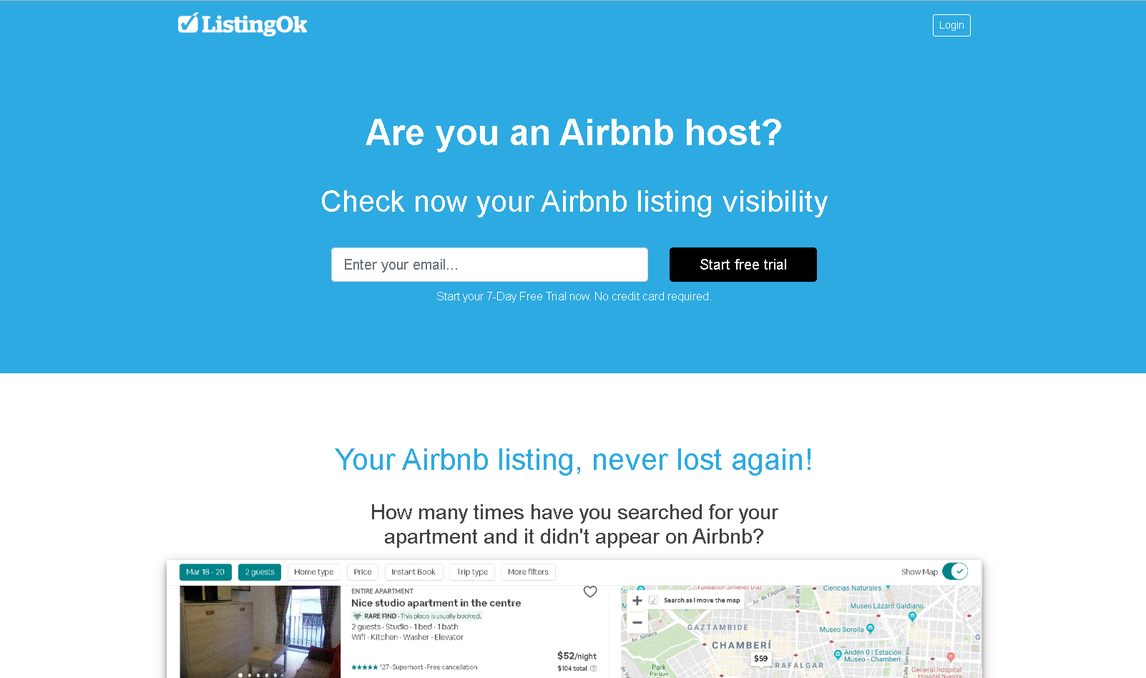
- Analyzer, a free tool that scores an Airbnb listing in a couple of clicks. It works as an acquisition product — the user comes in without signing up, sees value in thirty seconds, then registers.
- Programmatic SEO: market pages generated automatically (Airbnb occupancy by city), in English and Spanish, indexable and linked from the blog.
- Bilingual EN/ES platform with separate routes (
/en/…,/es/…), fullhreflangand localised content — not auto-translated. - Firebase Auth login: email + social providers, session and verification handling, without writing our own identity system.
- Partner programme and templates for property managers, plus a blog and events integrated into the same domain for SEO.
Technical decisions that mattered
1. React + Vite SPA, served by Express with SEO-friendly routes
The application is a React SPA bundled with Vite, served from a Node/Express process. Vite gives us fast builds and vendor-split bundles (React separated from product code), keeping time-to-interactive low even as the app grows. Express handles the index fallback for deep links and the bilingual routing (/en/*, /es/*), so each language is its own canonical URL — not a parameter lost on the client.
2. Firebase Auth: buy what doesn’t differentiate
A SaaS with three people can’t spend two months building social login, password recovery, email verification and session handling. Firebase Auth solves all of that with an official SDK and a marginal production cost. The team focused on the pricing engine and the OTA connectors — which are the product. Generalisable lesson: in B2B SaaS, login is not a competitive advantage; the revenue model is.
3. Market ingestion pipelines, not on-demand scraping
Computing occupancy, ADR and RevPAR in real time against Airbnb every time a user opens a screen is expensive and fragile. We chose scheduled ingestion pipelines that pre-process the markets that matter and leave them ready to serve, with aggressive caching. The side benefit is that the same data feeds the programmatic SEO pages — one base layer powers both product insights and site indexability.
4. Bilingual for real, not translated
The vacation rental market is global. Going EN/ES from day one — full hreflang, separate sitemaps (sitemap-en.xml, sitemap-es.xml) and localised URLs (/es/precios/ vs. /en/pricing-revenue-management-software/) — was an upfront cost that pays itself back: every blog article and every market page lives indexable in two languages, doubling the SEO surface without doubling the content team.
5. A free tool as the front door
The Analyzer was born as an acquisition tactic: paste an Airbnb URL and see a score with recommendations, no signup. It’s the piece that generates the least revenue and delivers the most qualified traffic into the funnel. The rule here: in niche SaaS, a free public utility outperforms any paid campaign of the same cost.
Outcome
ListingOK has been operating as a product since 2023 and continues to grow. The platform is genuinely bilingual, indexable in EN and ES; the free Analyzer still acts as the front door to the funnel; the blog and per-city market pages are updated weekly and have built up an organic SEO base that a three-person team couldn’t sustain through paid alone. Internally, the client / services / pipelines separation means each new capability — a new channel, a new market, a new pricing model — drops in without touching the rest.
And the most underrated decision with three years of hindsight: buying the auth. Every time someone asks “but didn’t it cost you to build the auth?”, the answer is still “no, and that’s why we shipped the pricing engine in the first quarter”.
Got a SaaS in mind? Let’s talk about yours.
If you have an idea or a stuck technical project, the first call is free and lasts thirty minutes. Maybe something comes of it, maybe not — but you’ll know more by the time we hang up.
Let’s talk →